September 17, 2026
Wood Privacy Fence Boards Warping and Graying? Why Tri-State Humidity Does It
A light orange tint on chain-link wire after prolonged rain is normal and does not always indicate a serious problem. What matters is whether that discoloration is superficial or whether it has penetrated the galvanized coating and started consuming the steel underneath.
Surface rust can be wiped away or treated with a wire brush and rust-inhibiting primer. Structural rust is a different matter entirely. When the wire begins to pit, flake in layers, or crumble at pressure points, the zinc coating that protects the steel has been fully compromised. At that stage, the tensile strength of the wire drops, meaning the fence can no longer hold tension across its span or absorb lateral force without deforming.
What Surface Rust Looks Like Versus Structural Rust
Some very minor post movement happens naturally after installation as the concrete footing cures and the surrounding soil settles. That is a one-time event that stabilizes within the first season. Ongoing leaning is a separate problem with distinct causes.
Posts lean for three primary reasons: footing failure due to frost heave or soil erosion, corrosion at the post base as described above, or physical impact from a vehicle, falling branch, or sustained pressure from overgrown vegetation. Each cause requires a different repair approach, but all three share the same consequence: a leaning post transfers stress unevenly across the entire fence line.
The Difference Between Settlement and Structural Failure
Leaning or Shifting Posts
What Happens When Leaning Goes Unaddressed
When one post tilts, the tension wire and top rail attached to it shift out of alignment. This loosens the mesh across adjacent spans, creates gaps at the bottom, and puts abnormal strain on the next post in line. A single leaning post left for one full season can pull two or three neighboring posts into misalignment. What began as a single repair becomes a multi-span correction.
Why Rust Accelerates in Specific Zones
Rust almost always starts at the points where the fence contacts soil, concrete footings, or standing water. The bottom rail and the lowest few inches of mesh are the highest-risk areas because moisture sits there longest. In regions with acidic soil or heavy clay, the contact point between the footing and the post corrodes from the inside out, which means the visible surface looks intact while the base is hollowed.
Once rust compromises a post base, the entire panel above it loses its anchor. A fence that appears upright may have almost no structural integrity left at ground level.
Planning Around Behavior, Not Just Breed
Quick Answer: Wood fence boards warp and cup because they take on and release moisture unevenly as humidity swings through the tri-state year, and they turn gray because ultraviolet light breaks down the lignin that holds the surface wood fibers together. Freshly milled Southern pine can leave the sawmill at up to 19 percent moisture content, then settle toward the 12 to 14 percent equilibrium moisture content typical of north Alabama, and that settling is what pulls boards out of flat. Graying is a surface-only change and usually shows up within six months to two years of installation no matter the wood species. A board that has gone gray but still feels firm and sounds solid when tapped is weathering normally, while a board that feels soft, spongy, or crumbles at the edge has moisture damage that runs deeper than color. Board orientation, ground clearance, and a maintained stain schedule are what actually slow both problems down.
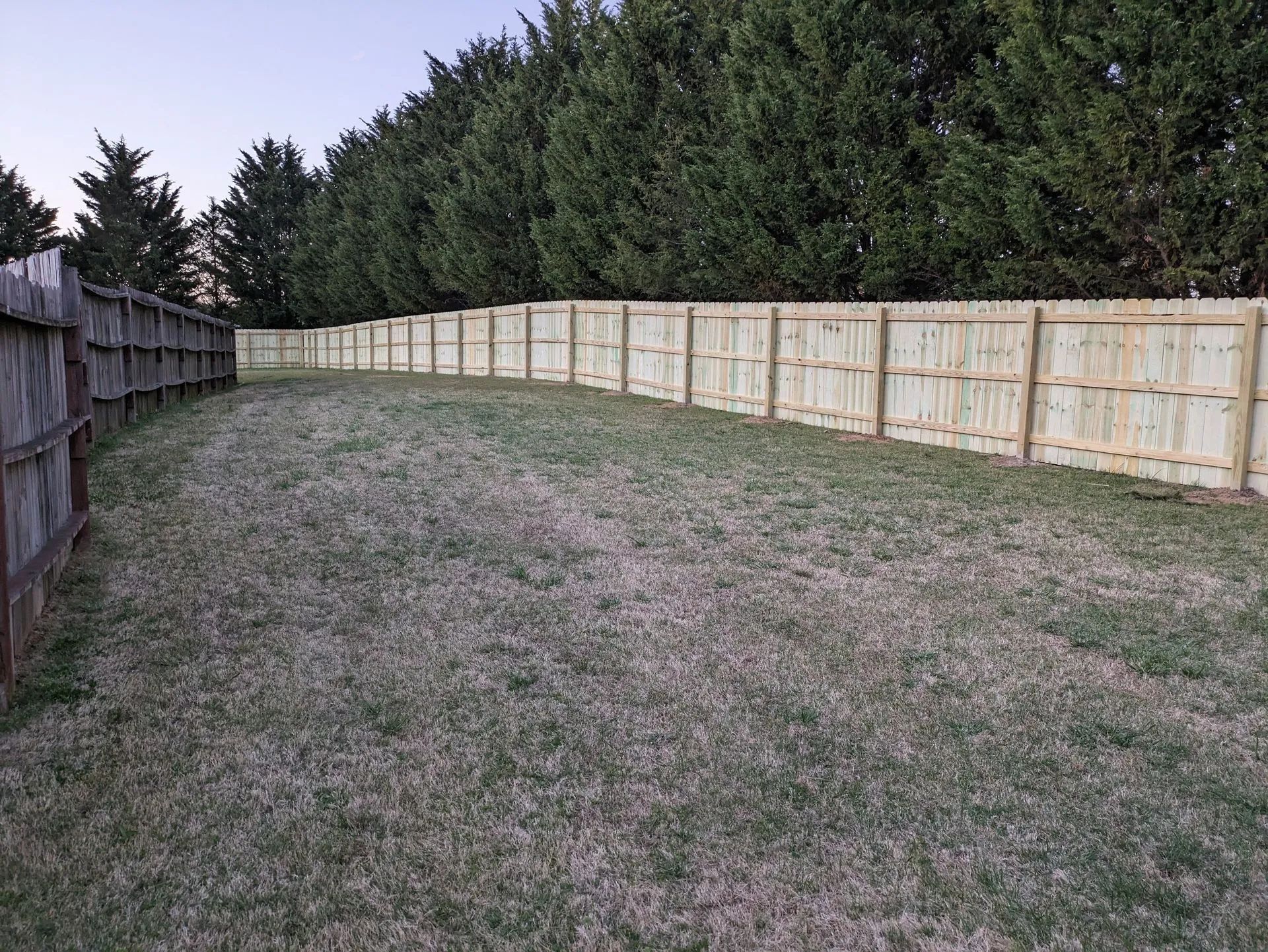
Your privacy fence looked sharp the day it went in, warm cedar-toned boards running tight and flat along the property line outside Rainsville. Eighteen months later, the color has faded to a patchy silver-gray, and a handful of boards near the sunniest stretch have started to cup, edges pulling away from the panel enough that daylight shows through where it didn't before. Nothing about the install looks wrong. The posts are still plumb, the rails are solid, and there's no rot at the ground line. The wood just looks tired faster than you expected, especially for a fence that isn't even two years old.
That timeline is normal for this part of the country. It comes down to two separate processes that just happen to show up together. One is moisture moving in and out of the wood as humidity swings through the seasons, which is what pulls boards out of flat. The other is sunlight breaking down the wood fibers at the surface, which is what turns the color gray. Neither one means the fence was built wrong. And neither one signals structural failure on its own. Knowing which is which, and what actually slows each one down, is the difference between a fence that ages gracefully for another decade and one that gets replaced years before it needed to be.
Why Tri-State Humidity Puts More Moisture Into Wood Than Drier Climates
Wood Moisture And Regional Climate
Wood is hygroscopic, constantly exchanging moisture with surrounding air until reaching equilibrium moisture content, or EMC. Temperature and relative humidity determine EMC, which varies regionally. Huntsville, Alabama averages roughly 12.4 to 14.3 percent outdoors, while Las Vegas can reach 3.7 percent, helping explain regional differences in fence movement throughout the year.
High Humidity Means Less Relief Between Rain Events
In drier climates, wood can dry substantially between storms. Across Scottsboro, Fort Payne, Section, and surrounding areas, summer humidity often remains high overnight and mornings, preventing boards from fully releasing moisture before another rain. That persistent dampness keeps fibers swelling and shrinking instead of settling into a stable shape between weather events.
The Swing Matters As Much As The Average
Moisture swings matter as much as averages. A board staying near 13 percent moisture content year-round generally holds shape better than one moving from 10 percent during dry weather to 16 percent after wet periods. The tri-state area's limited drying stretches can accelerate fence movement, warping, and dimensional changes over time.
The Real Reason Boards Cup and Warp
Warping Isn't A Sign Of Bad Lumber
Warping isn't necessarily evidence of poor lumber; it can result from wood adjusting to its environment. Southern Pine kiln-dried dimension lumber may contain up to 19 percent moisture when sold. Installed where equilibrium sits around 12 to 14 percent, boards release moisture unevenly, causing fibers to shrink differently and deform.
One Face Almost Always Dries Faster Than The Other
The weather-facing side of a fence board usually dries faster than the sheltered side. South- or west-facing surfaces receive greater sun and wind exposure, creating uneven moisture loss across the board. That difference produces mechanical stress that causes cupping, which explains why sunniest fence sections often warp before shaded areas.
Wet-Dry Cycling Does More Damage Than Steady Moisture
Repeated wet-dry cycles can create greater stress than consistently damp conditions. Rain rapidly increases moisture, while intense summer sunlight quickly removes it, forcing fibers to repeatedly swell and shrink. Each cycle increases movement, while lower-quality pine with unfavorable grain orientation can be especially vulnerable to cupping under repeated environmental stress.
Tip: Ask whichever crew builds or repairs a fence about board orientation before installation. Boards installed with the tighter growth rings facing outward toward the weather tend to cup less over time than boards installed the opposite way, and slightly wider gaps between pickets let air move through and dry both faces at closer to the same rate.
What's Actually Turning the Wood Gray
Graying and warping are often blamed on the same cause, but they come from different mechanisms and don't always show up together. The color change is driven almost entirely by ultraviolet light. Research on wood weathering published through NC State's BioResources journal shows that UV exposure degrades lignin, the compound that binds and colors wood fibers at the surface, breaking it down into compounds that wash away in rain and leave behind a thin layer of grayed, exposed cellulose. This is a surface-only reaction. It doesn't penetrate more than a few thousandths of an inch into the board, which is why a gray board can still be structurally sound underneath.
Sun exposure decides the pace, not the outcome
Every unfinished or unsealed wood species eventually turns some shade of silver-gray in outdoor exposure, cedar and pine included. What differs by property is how fast it happens. A fence catching full sun most of the day in an open lot outside Trenton or Dalton will greet its gray phase well before a shaded fence line tucked under trees closer to Chattanooga.
Not all discoloration is the same discoloration
Even, uniform silvering is UV weathering and is purely cosmetic. Dark gray, black, or greenish blotches, especially in spots that stay shaded and damp, usually point to mold or mildew growing on the surface rather than sun-driven graying. Mildew feeds on the moisture sitting in the wood grain and tends to concentrate near the ground, behind shrubs, or on the north-facing side of a fence that doesn't get much direct sun to dry it out.
Cosmetic Weathering Versus Real Damage: How to Tell the Difference
Most homeowners who notice graying or minor cupping assume the worst, but the two conditions described here are almost always cosmetic rather than structural. The distinction comes down to a simple physical test rather than a guess based on appearance alone.
Press And Probe Before Worrying
Press a thumbnail or flathead screwdriver into a gray, cupped board. Healthy weathered wood should remain firm and resist pressure. Decaying wood feels soft, spongy, or allows the screwdriver tip to sink easily. This quick test can distinguish cosmetic weathering from deterioration before assuming the entire fence needs replacement.
Sound Is A Fast First Check
Tap the board with your knuckle. Healthy wood generally produces a solid, slightly hollow sound, while decayed wood may produce a dull, muted thud, especially when softness is present. Pay particular attention near ground level and areas touching soil or mulch, where prolonged moisture exposure accelerates deterioration over time.
Isolated Versus Spread-Out Damage Tells Its Own Story
A few warped or discolored boards scattered along a fence usually indicate normal weathering. Damage concentrated within one section, particularly near downspouts, sprinklers, or low areas where water collects, suggests localized moisture exposure. Identifying that source matters because correcting drainage or moisture problems may prevent further deterioration without replacing unaffected boards.
Warning: Resist the urge to stain or seal a fence right after a heavy rain, even if the wood looks dry on the surface. Trapping residual moisture underneath a fresh coat of sealant blocks the wood's ability to release that moisture normally, and it can accelerate the exact rot and decay that a properly timed stain job is meant to prevent. A moisture meter reading under roughly 15 percent, or a few dry, sunny days after the last rain, is a better signal that the wood is ready for a finish.
What Actually Slows Warping and Graying Down
None of this is fully preventable in a climate this humid, but the pace of both warping and graying responds directly to a handful of choices made at installation and upheld afterward.
Ground Clearance Keeps The Bottom Edge Out Of Standing Moisture
Leaving a small gap between the bottom of the boards and the soil, rather than setting them flush to grade, cuts down on the sustained dampness that accelerates both decay and cupping at the base of the fence.
Spacing And Airflow Matter More Than Most Homeowners Expect
Boards installed with a small gap between pickets, rather than tight against each other, dry more evenly on both faces after rain, which reduces the differential shrinkage that causes cupping.
A Maintained Finish Schedule Slows The UV Clock
Semi-transparent stains and sealants contain UV-blocking pigments that slow lignin breakdown at the surface, but that protection wears off. Reapplying every couple of years, rather than treating a single stain job as permanent, keeps the graying process from accelerating back to its unfinished pace.
Vegetation And Drainage Control Moisture Load
Trimming back shrubs and grass that hold humidity against the fence line, and directing gutters or downspouts away from the fence rather than onto it, removes some of the extra moisture exposure that pushes both warping and mildew growth beyond what sun and seasonal humidity alone would cause.
Frequently Asked Questions
How long does it typically take for a new wood fence to start turning gray?
Most unsealed wood fences show visible graying within six months to two years, faster in full sun. Sealed or stained fences delay the color change but don't stop it, since the coating itself wears down with UV exposure over time.
Can a gray, weathered wood fence be restored back to something close to its original color?
Yes, in most cases. Graying is a thin surface layer, so a gentle pressure wash followed by a wood brightener removes much of it and exposes fresher wood underneath, ready for sealing or staining.
Does a cupped or warped board mean the fence needs to be replaced?
Not usually. A cupped board that still feels firm is cosmetic, and single warped boards can be replaced without rebuilding the fence. Widespread warping paired with soft, spongy wood suggests the lumber or install wasn't suited to the site.
Why do some boards on the same fence warp more than others?
Sun and wind exposure aren't even across a fence line. Boards facing full sun dry faster than shaded ones, causing cupping. Grain orientation and milling moisture also vary board to board, so neighboring boards age differently even under identical conditions.
Is cedar less likely to warp than pressure-treated pine in humid tri-state weather?
Cedar and treated pine both swell and shrink with humidity, so neither resists warping fully. Cedar's natural oils offer some early moisture resistance, but that advantage fades as the oils weather out, narrowing the gap between the two over time.
Does staining a wood fence stop it from graying permanently?
No finish stops graying for good, since UV exposure keeps degrading unprotected wood, including stained wood once the coating thins. Staining slows the process by years and holds color longer, but needs reapplication on a regular schedule.
A Weathered Fence Usually Isn't a Failing One
A gray, slightly cupped wood fence in the tri-state area usually isn't a fence that failed. It's a fence responding exactly the way wood responds to a climate that rarely lets it fully dry out and gives it plenty of sun to break down at the surface. The gray comes from lignin loss under ultraviolet light, and the cupping comes from uneven moisture movement between the two faces of a board. Both processes stay cosmetic until a probe test or a soft spot says otherwise.
What changes the outcome is attention paid before and after installation: the right species and board thickness for the site, orientation and spacing that let boards dry evenly, ground clearance that keeps the bottom edge out of standing moisture, and a stain schedule that actually gets kept up rather than applied once and forgotten. Simply Fencing LLC
has spent over 8
years installing and repairing custom wood fencing out of Higdon, AL, matching board selection and maintenance to how humidity actually behaves on tri-state properties.